Monday, 15 June 2015

Dr. G. U. Pope

G.U.POPE

George Uglow Pope was born on 24 April 1820 in Prince Edward Island in Nova Scotia. His family migrated to England when he was an infant. Even as a child he cultivated many  languages. He left for South India in 1839. It was at Sawyerpuram near Tuticorin.
     Sawyerpuram is a town panchayat in Tuticorin district, Tamil Nadu, India. Since missionary Dr. G. U. Pope ministered in this place the population is predominantly Christian. This place is an historical and religious place. It was first a settlement of persecuted Christians on land provided by Mr. Sawyer, an Anglo-Indian layman in the employ of the East India Company. The village thus formed in 1814 was gratefully named after him as Sawyerpuram. The Christian settlers quickly organized themselves, and by 1838 had built for themselves a small church and a school attended by 10 children. However, it was with the advent of intrepid young Dr. G. U. Pope in 1842 that Sawyerpuram shot into prominence in the annals of missionary history. He established in 1844 the renowned “Sawyerpuram Seminary”, which for a long time was the nursery of hundreds of Indian clergymen, teachers and catechists. The esteem in which this reputable centre of learning was held can be seen from the fact that the Oxford University contributed to the formation of a suitable library within its walls. Dr.G.U Pope is a Tamil Patron.
"The Student of Tamil" bloomed into a scholar of Tamil, Sanskrit and Telugu. Pope setup several schools and taught Latin, English, Hebrew, Mathematics and Philosophy. As he was a martinet he was always in trouble. Of him Bishop Caldwell said: "The chief drawback to his success was the severity of his discipline which led, after a succession of petty rebellions, to his withdrawal". Pope believed in the theory: "Things have tears". He worked with the motto: "Conscience within and God above". He completed his translation of Tirukkural on September 1, 1886. His "Sacred Kural" contains introduction, grammar, translation, notes, lexicon and concordance. It also includes the English translation of F.W.Ellis and the Latin Translation of Fr. Beschi. It is a tome of 436 pages. He had, by February 1893, translated Naaladiyaar. His magnum opus, the translation of Tiruvachakam appeared in 1900. Of this he says: "I date this on my eightieth birthday. I find, by reference, that my first Tamil lesson was in 1837. This ends, as I suppose a long life of devotion to Tamil studies. It is not without deep emotion that I thus bring to a close my life's literary work". The much coveted Gold Medal of the Royal Asiatic Society was awarded to him in 1906. He passed away on 12 February 1908. The services of this great soul to Tamil and Saivism defy reckoning by weights and measures. In his last days he was a mature Saiva Siddhanti, with his faith as ever rooted in Chiristianity. He delivered his last sermon on May 26, 1907.
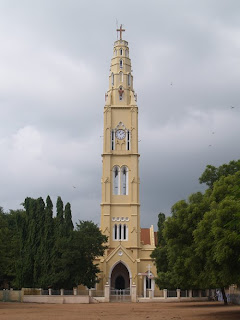
Dr. G U Pope’s efforts were equally directed to the extension of the Church. He built the All Saints Church at nearby Subramaniapuram enduring extreme hostility and insult. The lovely red-brick Holy Trinity Church at Sawyerpuram was built by Rev. Huxtable and Rev. Sharrock and dedicated on 11 November 1877 by the Most Rev. Johnson, Metropolitan of India.

Rev. Canon Arthur Margoschis


 St.John’s Cathedral,Nazareth
Many eminent Missionaries rendered significant services not only to the growth of Christianity but also to the development of Nazareth in manifold dimensions. Of whom, the contribution of Canon A. Margoschis to the many sided growth of this village is matchless and unique. It is quite fitting to call the Rev. Canon Arthur Margoschis as “FATHER OF NAZARETH”. Words are inadequate to express the magnitude of works passionately done by him to this rural area. The remarkable development of Nazareth with the educational insititutions, the orphanage and Art Industrial School, the hospital and the church is principally due to the result of the untiring and unparalleled service and efforts of the great missionary Canon A. Margoschis.
The fact that cannot or should not escape our knowledge is that during decades of the 19th Century, Nazareth was identified as a small hamlet situated near Valaiyadi or Vahuthankuppam and the people of Nazareth had to get things from the shops or the neighbouring villages crossing the sandy soil clustered with the bush and trees. Such a backward un-recognised hamlet has become a recognized and developed place with all facilities owing to the pioneering work, meticulously done by canon Margoschis, inspite of many untold difficulties. “Great actions speak great minds” says John Fletcher.
It is of great interest to know a little about the life of such great man and also his great deeds done to this village. Arthur Margoschis, the eighth and last child to his parents was born on 24-12-1852 at Leamington, England and was broughtup in good Christian tradition. He had good education and was a gem of students. Though he had suffered a lot from Asthma from his childhood, he was very firm in using himself in the service of His Master, Jesus Christ. The burning zeal in him to become a missionary drove him to learn theology and then medicine. It was so dramatic that he embraced the work of a missionary when he was doing his final year of medicine. God found a great missionary in him and sent him to this place as His servant.
To epoch-making event in the history of Nazareth is that Canon A. Margoschis became the missionary of Nazareth in December 1876. He plunged into his work with enthusiasm and felt the need to do a lot to alleviate the sufferings of the helpless and poverty stricken people. Religion did not engender in Canon Margoschis the desire to run away or escape from the problem of life, On the contrary, his deep commitment to religion kept him in the service of the needy also. A few of his important works be mentioned.
Canon Margoschis gave a paramount importance to spiritual life and proved himself and eminent missionary in many a way. “Special Gospel campaign” among Hindus was vigorously done. Consequently thousands of persons were converted to Christianity. Scripture classes were conducted not only to children but also to the old people. As the number of Christians increased, the then church became too small to hold the congregation. He took efforts to extend the area of the church so as to accommodate more number of people. The newly constructed altar of the then Church was dedicated by him in 1884. The deadly cholera spread during 1902 was shocking but was a blessing in disguise. His faith in God was so great that he wished to have the communion service everyday since 6-12-1902 as a remedy to the dreadful malady. Communion being served everyday in this Church even to-day is a rarity found in a few churches only. “Nazareth Children’s Mission” was organized by him in 1903. He adopted different methods of raising funds from the local people for self-support. He was contemplating the construction of a bigger church to accommodate the ever increasing number of Christians at Nazareth. But his death on 27-4-1908 snatched him away from fulfilling his ardent wish.
 St. Luke’s Hospital, Nazareth :
Though it was founded in the year 1870 by Dr. J.M. Strachan, the monumental growth was under the able stewardship of Canon A. Margoschis. As he had the knowledge of medicine, he could do marvelous medical service, helping thousands of sick flocking even from 20 to 30 miles away. This service was rendered freely to all irrespective of caste and creed. There was a dire need to provide more facilities to the swelling number of sick in the hospital with wards, compounding room etc., To meet the requirements, the main building of the hospital was built by him in 1892 and the hospital was Christened “St. Luke’s Hospital” by him on the day of St. Luke’s (18th October) in 1892. With this meritorious medical service, he was esteemed a ‘Life – saver’. The command of Lord Jesus Christ, “Heal the sick …. Preach the Gospel” was faithfully followed by this medical officer-in-charge of the hospital from the year of his arrival in 1876 to the time of his death in 1908.
The ravage of famine swept away 25% of the local population and left many helpless. Owing to acute poverty and deadly diseases many were in untold miseries and became orphans. Canon Margoschis the only hope of the deserted people, built a small hut hundred yards away from his bungalow for the orphans in 1877. As the number of orphans increased, he took all efforts to put up a building for them and the same was built in 1878 in the place where the Art Industrial School is now. He was made aware of his responsibilities and obligations towards the less-privileged and was very anxious to introduce teaching for them on industrial courses. Hence he founded the Art Industrial School in the orphanage itself on 14-11-1878. Carpentry, Black-smithy and sewing courses were started and then weaving section was introduced. In 1884, the first sewing machine was bought and the art of tailoring was introduced. The lower Secondary Training was provided and in 1900, Upper Secondary Training was transferred from Tuticorin to Nazareth. He was the manager of the school till his death. In those days the Art Industrial School, the brain-child of Canon Margoschis, was praised as the only one of its kind in the district and the oldest in the Presidency of Madras. He lovingly adopted orphans and carried out the responsibilities of a father. “Verily I say unto you, in as much as ye have done it unto one of the least of these brethren, ye have done it unto me” -St. Mathew XXV,40
Girls High School
Canon Margoschis was made superintendent of the school 1876 itself. He founded Teachers Training School in 1877. He also stressed the need for good education to women and started kindergarten school. In 1886, he made a historic achievement of upgrading the Normal school to a High School. The school became a full-fledged high school in 1888 and the first set of women in the Presidency of Madras to pass the Matriculation Examination was from this school. The Standard of the school was very much appreciated by the Director of Public Instruction in 1890. This school is the first high school for women in south India.
Boy’s High School :
Canon Margoschis founded a Middle school for boys in 1882 in the name “Anglo – Vernacular School”. It is heartening to know that in 1885 ; this school was awarded “ The Best School” title in the Presidency of Madras, He made a successful venture of upgrading it as “High School “ in 1889 inspite of the stiff opposition from the then Bishop Rt. Rev. Caldwell. This infuriated the Bishop who closed down the High School section in 1892.
Theological Seminary :
Another brain – child of Canon Margoschis was the Theological Seminary. It was founded by him in 1890 with eight students. It had grown from strength to strength in the following years.
Other Developments and Benefits :
Since Canon Margoschis adopted Nazareth as his “Child”, he put his heart and soul to see Nazareth filled with many blessings of God. With the help of the orphans and hired laborers, he laid the metal road from Nazareth to Valaiyadi and planted trees on both sides. Telegraphic office was opened on
25-12-1894, as a result of the initiative taken by him. He showed interest in town planning also and the 5th street was formed by him. As a result of his efforts, the original plan to lay the railway line from Tirunelveli to Tiruchendur via. Thenthiruperai was changed and it was decided to lay it via. Nazareth. This monumental work, which transformed the very face of Nazareth, was put into operation a few years after his death.
Adult Education Programme was launched by him in 1880 at Nazareth and other neighboring villages. “S.P.G. Nazareth Christian Death Aid-Fund” was setup by him on 1-4-1884. It is gratifying to note that by the end of 1900, Rs. 66,331 was contributed to the bereaved families. He founded “S.P.G. Widows’ Association” to help the helpless widows. Such were the manifold benefits which the people of Nazareth enjoyed owing to his selfless service. “Well done, thou good and faithful servant” – St. Mathew XXV, 12.
The Great Man, who had endeared himself to the people of Nazareth passed away on 27th April 1908 and the sad news gave a rude jolt to them. The loss was irreparable. They wanted to build a bigger church in memory of him but later the idea was changed to be in conformity with his lofty ideals. The Boy’s High School was named after him. Recently a college was built here in memory of him. We owe it to posterity to perpetuate the memory of such a great missionary, by means of such things which will truly reveal the man and inspire others to follow the ideals which he symbolised.
The 32 years of selfless service of Canon A. Margoschis has left an indelible mark on the History of this area. His dedicated service to this people will remain a memorable historical fact for people of all religions and cultural traditions. He excelled all other missionaries who came before and after him to Nazareth by virtue of being not only a missionary but also being a doctor an educationist, a philanthropist, a philosopher, a guide, a friend, a father and what not. When Canon A. Margoschis left this world on 1908, he left behind the memory of a great and good life, lived usefully a memory that has become a legacy, one that deserves to be passed on to generations unborn.
“ Lives of great men all remind us
We Can make our lives sublime
And, departing, leave behind us
Foot prints on the sands of time “


Original Article
 

Reverend Charles Theophilus Ewald Rhenius - The Apostle of Tirunelveli (5 November 1790 – 5 June 1838)

Reverend Charles Theophilus Ewald Rhenius - The Apostle of Tirunelveli (5 November 1790 – 5 June 1838) was a German born missionary of the Church Mission Society (CMS). He was the first CMS missionary to arrive at India. For his missionary work in the Tirunelveli district he came to be known as the "Apostle of Tirunelveli" He was involved in the attempt to revise the Fabricius version of the Tamil Bible and also published a Tamil grammar book. Rhenius’ split from the Anglican Church in 1830 and started his own congregation. Rhenius' work was recognized in 1978 by the Reverend Daniel Abraham, the then Church of South India (CSI) bishop of Tirunelveli diocese. Rhenius's work was given official recognition by the Anglican Communion during the Tirunelveli diocese bicentenary celebration in 1978, in which, all the bishops, including Anglican bishop Stephen Neill and all the presbyters took an oath in front of the tomb of Rev Rhenius to follow the path of the resting soul, regard to evangelism
Early life
Charles Rhenius was the second son of Otto Gottlieb Nikolaus Rhenius, an officer in the Prussian army. When Charles was six years old, his father died. Charles left school when he was fourteen and went to work in his uncle’s office. After he had worked for three years another uncle called him to come and live with him. This uncle was a rich landowner. There were many missionary magazines in his uncle’s house. As he read these, Charles felt God was calling him to go overseas as a missionary. Though his uncle was unhappy about his decision, he accepted it. But his aunt tried to get him to change his mind. Charles had to struggle in prayer to overcome the temptation. As his uncle had no children, he planned to leave all his property to Charles[3]. Rhenius went to Berlin to study theology at a missionary college of Basel. When he left home he did not dare to tell his family of his final plans. When his suspicious mother Catharina Dorothea Schiemann, implored him not to go overseas, Rhenius replied "Dear mother, what am I to do if the Lord should so order it?. After a year at the seminary Charles Rhenius was ordained as a Lutheran presbyter.
With the Church Mission Society
In the early 19th century, the Church Mission Society was looking for missionaries for Dr John’s Schools of the Danish Mission at Tharangambadi in India. Among those who came forward, Rhenius and Schmarre were selected and given orientation on mission skills for 18 months in England. In 1813, the British parliament passed a new Act.[4] This Act allowed missionaries freedom to enter India.[5][6]. Both could get a berth on a ship only in February 1814. At the last minute his family tried to stop Rhenius going to India. His brother appealed to him by writing that their mother was weeping for him. CMS arranged a farewell meeting for him that was attended by more than 2,000 people.
Rhenius's journey to India was eventful: he experienced a fire aboard the ship and it was almost wrecked near Maldives. They reached safely Madras, only to learn that Dr John, under whose aegis they had planned to work as missionaries, was dead. Rhenius and Schmarre managed to stay for two weeks with the chaplain of the British East India Company in Madras. Then they went to Tharangambadi to learn the Tamil language.
Missionary work in Madras
After five months of language training, Rhenius was asked to come back to Madras, as CMS had decided to engage him in their own mission called Mission in Madras, instead of helping the Danish Mission at Tharangambadi. The Madras Governor gave permission to work in the Black Town of Madras. The rented a house belonging to a Hindu. This facilitated to study the Hindu scriptures and he visited the Kanchipuram temple as well. Through his studies, Rhenius came to believe that Hindus had once believed in one supreme god and the current polytheism was a later development. He fashioned his proselytizing method according to the belief - by appealing Hindus to go back to monotheism and the worship of Jesus Christ. He started a school in the Black Town, Madras. When the Hindus in Kanchipuram invited him to start a school, he agreed. After starting several schools in Madras, he extended his missionary work to Palmaner and Vandavasi, where he was exposed to the religious doctrines of Jainism. During his travel he recorded in his diary that the caste Hindus did not allow him to enter their house and on one occasion he had to spend the night in a cow shed.
In 1815, the Bible Society in Calcutta decided to revise the Johann Phillip Fabricius version of the Tamil Bible. Rhenius was asked to help with the revision. Assisted by a Munshi he set to work on the revision. On his travels Rhenius had talked with many Hindus. He found that very often they could not under stand the Bible translation of Fabricius. Further a conversation with a Brahmin showed what great care was needed in translating the idiomatic expressions. They were discussing Matthew 3:7, "you snakes..". The Brahmin had taken the words literally - he thought the people had really turned into snakes[7] This made Rhenius realize that a revision of the Bible was not sufficient - a new translation was necessary. He began a new translation of the New Testament. When he showed his translation to his Hindu friends, they had said that they could understand his translation. He wrote down some principles of translation. Thous his ideas on translation were not accepted in his time, they are similar to the current ones followed by the Bible Society. On 5 November 1817, a group of Protestants, Roman Catholics and Hindus met in Madras and formed the Tamil Bible Association. Rhenius also wrote a work of Tamil grammar titled "A Grammar of the Tamil Language: With Appendix", which was published by the American Mission Press at Madras in 1859.
Missionary work in Tirunelveli
In 1816, the historian, the Reverend James Hough, was the chaplain to the English garrison in the Palayamkottai fort and cantonment. He was interested in village ministry and wrote to the CMS asking for a missionary. By this time, the differences of opinion between Rhenius and the Madras Committee of the CMS had grown greatly. Rhenius was at the point of resigning and going home. However, the CMS did not want to lose a skilled missionary and suggested that he could go to Palayamkottai to assist Hough. Rhenius arrived in Tirunelveli on 7 July 1820. The first CMS congregation in Palayamkottai (present day Holy Trinity Cathedral, Palayamkottai) came into existence on 10 March 1822 and adjutant (current venue of Cathedral Higher Secondary School, Palayamkottai) to the CMS Church, Murugankuruchi, Rhenius started the Palamcottah Preparandi Institution. In 1824, he purchased valuable property to the north of the High Road in Palayamkottai (current venue of the Bishop Sergeant Training School, Palayamkottai) from his Hindu friend and philanthropist, Vengu Mudaliar, for a confessional price of just Rs. 750.00 and shifted the Preparandi School to the newly acquired campus. Operating from Palayamkottai, Rhenius covered a number of villages all over the Tirunelveli district, which include the current Thoothukudi district and part of Ramnathapuram district and planted small congregations. Solaikudiyiruppu is one of the oasis villages in the sandy dunes of Kudiramozhi Theri. When Rhenius visited Solaikudiyiruppu, the Mukandar of Solaikudiyiruppu Village was Velu Muthu Nadar. Rhenius converted Velu Muthu who was baptisied as "Vedha Muthu". Vedha Muthu, was the first Protestant Christian in the Megnanapuram Circle.
Villages of refuge
During the 18th century, Christian missionaries had witnessed persecution of converts coinciding with the Polygar Wars, by clubmen from the state of Ramanathapuram.[9]. To protect the new converts, Sundaranandam David,[10] a disciple of Rev. C. F. Schwartz, established a Christian satellite village - called Mudhalur, meaning First Village - near Sathankulam, which served as a refuge for local Christians. Following the Mudalur pattern, Rhenius started several Christian satellite villages, including Neduvilai (later known as Megnanapuram) (1825), Idayankulam (1827), Asirvathapuram (1828), Nallur (1832) and Surandai (1833). In 1827, Rhenius created a settlement for the Christians of Puliakurichi in a village he purchased with money donated by a Prussian nobleman, Count Dohna of Scholodin, and named it after him as Dohnavur. The village later became the place where Ami Carmichael founded the Dohnavur Fellowship to protect women rescued from prostitution.
Split from the CMS
In 1832, Rev. Rhenius wrote to the Madras Corresponding Committee of the CMS that an urgent need for more trained and ordained catechists, pastors, and teachers had prompted him to provide special training for some of the most promising young men, seven of whom he had ordained. Until now, precedents going back to Thanjavur and Tranquebar had been followed, whereby the local missionary enjoyed considerable autonomy in such matters. But the CMS Committee was now of the opinion that, although many Indians might have previously received ‘Lutheran orders’, the time for a change had arrived. Daniel Wilson, the new Bishop of Calcutta, indicated that loyalty to the Church of England required that workers under the CMS should henceforth be ordained, if at all, only according to the Church of England rites and not according to those of the Lutherans. Rhenius and his colleague, Bernard Schmidt, replied that their newly trained workers, as catechists, pastors, and teachers, had conscientious objections to following this new instruction.
At about the same time, Rhenius wote to the new Bishop of Calcutta welcoming him to India and extending to him an invitation to visit Palaiyamkottai as soon as possible. His reports, having dwelt at length on mass conversions then taking place, stressed the need for pastors to watch over new Christians and the recent ordination of seven promising young men. The reply he received, indirectly, declared that his actions were invalid and reprimanded him for violating the apostolic succession. Having waited in vain for the Archdeacon to publish his long dormant review, Rev. Rhenius published the review himself.
No mention was made of a second pamphlet that Rhenius had published at the very same time, entitled Union of Christians, an Address to all Christians, especially to all Ministers of the Gospel. He had attempted to bring about harmony among missionaries of different backgrounds. Instead publication of the first pamphlet provoked a drastic response. The conflict between the Anglican Diocese of Calcutta and Rhenius reached a low point after six catechists of Rhenius' choice refused to be ordained at Madras by the Anglican Bishop John Matthias Turner of Calcutta. A letter of dismissal was delivered to Rhenius by two CMS officers, informing him that his connection with the CMS was at an end and that, since the ‘territory’ in which he had been working belonged to the CMS, he should forthwith depart from Tirunelveli. He handed over all his belongings to Rev. John Tucker; along with his German colleagues he left for Thoothukudi, hired a boat and sailed to Madras. From there Rhenius traveled to Arcot, where he planned to start his own mission.
About the circumstances of his original appointment, Rhenius wrote at length:
When my fellow-labourer [Schnarre] and I were sent out to India, now twentyone years ago, no question was ever put to us on the subject of conformity to the Church of England nor have I received a single application from the Society to conform. I never concealed my sentiments and mode of proceeding I never promised to submit to the English bishops, not even to observe the Church of England forms. No such promise was even asked of me. The Committee of the Society, at that early period, did not even expect that German clergymen should conform to the Church of England.
Several catechists from Tirunelveli appealed to him to return, and Rhenius decided to do so. There, in reduced circumstances, both in Suveshipuram (‘Town of Salvation’) where a house was established in his honour, and in Tirunelveli itself where houses were made available to him, he tried to carry on his work. Money for his support came from all over India and from Europe. In Palayamkottai, the supporters of Rev. Rhenius stopped going to the CMS Church and started a prayer hall (The Present Chinna Koil - "St. John Church" ) for their worship at Aadaikalapuram. Similar splits happened in all the places, where Rhenius had planted churches, including Solaikudiyiruppu. Efforts to reconcile Rhenius and the CMS failed.
Death and legacy


Tomb of Rev. C T E Rhenius at Adaikalapuram, TirunelveliRhenius' health began to fail under the tension and strain caused by the division in the churches. He wanted every one to have a copy of the Bible in the language they could understand. On 5 June 1838, he signed notes to be sent to people in Palayamkottai. In these notes, he asked for subscriptions to the Madras Auxiliary of the Bible Society[12]. On the same evening at 7:30 pm Rhenius died. He was 48 years old at the time of his death. He was buried at Adaikalapuram, Palayamkottai. Rhenius's missionary work was recognized by the Tirunelveli Diocese of the Church of South India (CSI) during the diocese's bicentenary Celebrations in 1978. Rhenius tomb is currently being maintained by the Diocese. During his 15 years in Tirunelveli, Rhenius had set up as many as 371 congregations. His contemporary, the Jewish missionary Dr Wolf, who stayed with Rhenius for a week during September 1833 regarded him as the greatest missionary who had appeared since St. Paul.

Sunday, 14 June 2015

Lesser Known facts about Joseph and Mary


It’s no wonder that God chose Joseph and Mary to be the earthly parents of his son. Yet when one steps into their shoes its clear how they would have felt. Below are some of the lesser-known facts about Joseph and Mary.

Jesus studied from God Fearing Parents.

Jesus was taught the art of carpentry at a very young age,

When the Jesus forgave the women caught in Adultery John 7:53-8:11 he was just merely doing what his earthly father had done when he was in his mother’s womb.
Because Joseph her husband was faithful to the law, and yet did not want to expose her to public disgrace, he had in mind to divorce her quietly. - Matthew 1:19
For the punishment handed by God for such offence was death by stoning (Leviticus 20:10)

According to Luke 2:24 it is clear that Joseph was  a poor man and later when he was asked to go to Egypt by the angel (Matthew 2:13) the money brought by the wise men from the east helped finance his trip.

25 Great Bible Characters

…we are surrounded by so great a cloud of witnesses…
It is very important to surround oneself with people who can impact your life for the good and not for the bad. Here is a list of a few great men and women worth hanging out with 24/7.

1. Abel:
It was by faith that Abel brought a more acceptable offering to God than Cain did. Abel's offering gave evidence that he was a righteous man, and God showed his approval of his gifts. Although Abel is long dead, he still speaks to us by his example of faith. - Hebrews 11:4
Abel was the second son of Adam and Eve. He was the first martyr in the Bible and also the first shepherd. Very little else is known about Abel, except that he found favor in God's eyes by offering him a pleasing sacrifice. As a result, Abel was murdered by his older brother Cain, whose sacrifice did not please God. He is the first person to enter Heaven after death.


2. Enoch walked with God - Genesis 5:24
Enoch walked with God, and he was not, for God took him.
I’ve always been mystified by this guy. But from Genesis through Revelation, from the garden to the city, we see glimpses of how Enoch walked with God. He walked by faith, he walked in the light, he walked in agreement with The Lord. He also walked consistently, sincerely in obedience, union, and fellowship with The Lord.

3. Noah was a man who took God seriously.
Noah did this; he did all that God commanded him.-Genesis 6:22


4. Job was a man whose life and resolve was tested beyond imagination, yet did not curse God.
“In all this Job did not sin or charge God with wrong.” -Job 1:22


5. Abraham did nothing, yet got everything. He did not work for what he got. He simply received it by faith. The bible says he believed God. The world is yet to see what God can do to and through a man who would simply believe. He believed for a son even at 100 years old. He believed for a lamb when tested to sacrifice his own son. He embraced the promises even though he did not see them clearly
Abraham believed God and God counted him as righteous because of his faith.- Romans 4:3


6. Sarah, wife of Abraham, is one of only two women specifically named among the heroes of faith (Some translations, however, render the verse so that only Abraham receives credit.):

It was by faith that even Sarah was able to have a child, though she was barren and was too old. She believed that God would keep his promise.- Hebrews 11:11

Sarah waited long past child-bearing age to have a baby. At times she doubted, struggling to believe God would fulfill his promise. Losing hope, she took matters into her own hands. Like most of us, Sarah was looking at God's promise from her limited, human perspective. But the Lord used her life to unfold an extraordinary plan, proving that God is never restricted by what usually happens. Sarah's faith is an inspiration to every person who has ever waited on God to act.

7. Isaac, the miracle child of Abraham and Sarah, is the next hero distinguished in the Hall of Faith:

It was by faith that Isaac promised blessings for the future to his sons, Jacob and Esau. Hebrews 11:20

The Jewish patriarch, Isaac, fathered twin boys, Jacob and Esau. His own father, Abraham, was one of the greatest examples of faithfulness the Bible has to offer. It's doubtless Isaac would ever forget how God had delivered him from death by supplying the necessary lamb to be sacrificed in his place. This legacy of faithful living carried into his marriage with Rebekah, Jacob's one and only wife and lifelong love.

8. Jacob, another of Israel's great patriarchs, fathered 12 sons who became heads of the 12 tribes. One of his sons was Joseph, a key figure in the Old Testament. But Jacob started out as liar, cheater, and manipulator. He struggled with God his entire life.

The turning point for Jacob came after a dramatic, all-night wrestling match with God. In the end the Lord touched Jacob's hip and he was a broken man, but also a new man. God renamed him Israel, which means "he struggles with God."

It was by faith that Jacob, when he was old and dying, blessed each of Joseph's sons and bowed in worship as he leaned on his staff. -Hebrews 11:21

The words "as he leaned on his staff" are of no small significance. After Jacob wrestled with God, for the rest of his days he walked with a limp, and he gave over control of his life to God. As an old man and now a great hero of faith, Jacob "leaned on his staff," demonstrating his hard learned trust and dependence on the Lord.

9. Joseph was a man who was completely devoted to the Lord even in times of injustice, betrayal, and temptation.
“As for you, you meant evil against me, but God meant it for good, to bring it about that many people should be kept alive, as they are today.” -Genesis 50:20

Joseph is one of the greatest heroes of the Old Testament and an extraordinary example of what can happen when a person surrenders his life in complete obedience to God.

It was by faith that Joseph, when he was about to die, said confidently that the people of Israel would leave Egypt. He even commanded them to take his bones with them when they left.- Hebrews 11:22
After the terrible wrongs done to him by his brothers, Joseph offered forgiveness and made this incredible statement in Genesis 50:20, "You intended to harm me, but God intended it all for good. He brought me to this position so I could save the lives of many people.

10. Moses was a man of great humility. His humility caused God to take notice of him. When others attacked him, he didn’t try to justify himself, he stepped back and allow God to speak for him. When the load of leadership was too heavy he took the guidance of his father in-law. When God would have nothing to do with a stiff-neck people and threaten to destroy them for their evil ways, Moses offered his own life as he interceded for Israel.
Now the man Moses was very meek, more than all people who were on the face of the earth.

Numbers 12:3


11.Joshua
Against overwhelming odds, Joshua led the people of Israel in their conquest of the Promised Land, beginning with the strange and miraculous battle of Jericho. His strong faith caused him to obey, no matter how illogical God's commands might seem. Obedience, faith, and dependence on the Lord made him one of Israel's finest leaders. He set a brave example for us to follow.

While Joshua's name is not specified in this verse, as the leader of Israel's march on Jericho, his faith hero status is certainly implied:

It was by faith that the people of Israel marched around Jericho for seven days, and the walls came crashing down.-Hebrews 11:30


12. Ruth was a woman who left everything she had for something far more greater than anything she’d ever imagined.
But Ruth said, “Do not urge me to leave you or to return from following you. For where you go I will go, and where you lodge I will lodge. Your people shall be my people, and your God my God. Where you die I will die, and there will I be buried. May the LORD do so to me and more also if anything but death parts me from you.” And when Naomi saw that she was determined to go with her, she said no more.” -Ruth 1:16-18  


13. Samuel was a drama free scandal free prophet. A man of great integrity. A holy man of God. A man who refused to compromise. A man who said, “obedience is better than sacrifice.” A man who even thought it sinful to stop praying for the people God called him to serve.
Moreover, as for me, far be it from me that I should sin against the LORD by ceasing to pray for you, and I will instruct you in the good and the right way. -1 Samuel 12:23

14. David, the shepherd-boy king, looms large in the pages of Scripture. This courageous military leader, great king, and slayer of Goliath was by no means a perfect role model. Although he's ranked among the most notable heroes of faith, he was a liar, adulterer, and murderer. The Bible makes no attempt to paint a rosy picture of David. Rather, his failures are vividly displayed for all to see.

So what was it about David's character that made him such a favorite of God? Was it his zest for life and passionate love for God? Or was it his unshakable faith and trust in the endless mercy and steadfast goodness of the Lord?

15. Daniel was a man whose integrity and prayer life Helped him to see unbelievable miracles and prophetic mysteries.
“He went to his house where he had windows in his upper chamber open toward Jerusalem. He got down on his knees three times a day and prayed and gave thanks before his God, as he had done.” -Daniel 6:10 
 

16. Esther was a woman who understood her times and seized the day not only for her people but also for God.
“For if you keep silent at this time, relief and deliverance will rise for the Jews from another place, but you and your father’s house will perish. And who knows whether you have not come to the kingdom for such a time as this?” -Esther 4:14


17. Elijah was a man who availed himself in such a way to God. As a result, Gods used him mightily.
“Then the angel of the LORD said to Elijah, “Go down with him; do not be afraid of him.” So he arose and went down with him to the king.”- 2 Kings 1:15

18. Elisha was simply a bald headed miracle worker. You name it – he did it through the power of God. The healing of the waters at Jericho, God used him. The filling of the poor widow’s vessels with oil, God used him. The reviving of the Shunammite woman’s son, God used him. The feeding of a multitude on an insufficient quantity of food, God used him. The healing of Naaman, the Syrian captain, of leprosy, God used him. The raising of the iron ax which had fallen into the water, God used him. Even after his death, the very touch of his bones revived a man buried by accident in his sepulcher.

19. Nehemiah was a man who silenced the Nay Sayers and did what they said he couldn’t do.
Then I replied to them, “The God of heaven will make us prosper, and we his servants will arise and build, but you have no portion or right or claim in Jerusalem.” -Nehemiah 2:20


20. Ezra was a scribe who knew how to attract the favor of The Lord upon everything he did. He made it his duty to study the word of God – not just read it. He also spend much time in fasting and praying over the word. For these reasons everything he touch literally turned to gold. The hand of God was upon him and he succeeded in everything he did.
for the good hand of his God was on him… For Ezra had set his heart to study the Law of the LORD, and to do it and to teach his statutes and rules in Israel. So we fasted and implored our God for this, and he listened to our entreaty.- Ezra 7:9, 10; 8:23

21. John the Baptist seemed to have it all together. Jesus called him the greatest man who ever lived. I can still hear his words, “I must decrease – He must increase”, ring in my heart. A powerful testament to his humility. But the thing that speaks more to me about John is the fact that he was human, frail, and doubtful – just like me. Even though he had a miraculous birth, saw the Holy Spirit come down upon Jesus, and heard the voice of God from heaven – in his moment of weakness, behind bars questioned what he knew was true.
Calling two of his disciples to him, sent them to the Lord, saying, “Are you the one who is to come, or shall we look for another?” -Luke 7:19

22. Paul was a man so passionate for the lost, that he literally would have walked upon broken glass just to reach the next person.
“A prophet named Agabus came down from Judea… took Paul’s belt and bound his own feet and hands and said, Thus says the Holy Spirit, ‘This is how the Jews at Jerusalem will bind the man who owns this belt and deliver him into the hands of the Gentiles… For I am ready not only to be imprisoned but even to die in Jerusalem for the name of the Lord Jesus.” Acts 21:10-14

23. Phillip was a man who chose to live by the spirit; follow His promptings; and be used by the Spirit.
“Rise and go toward the south to the road that goes down from Jerusalem to Gaza.” This is a desert place… And there was an Ethiopian.” Acts 8:25-40

24 Timothy was a young man with a tremendous gift and calling. The only thing that was slowing him down was himself. He was extremely timid and shy. Especially leading a congregation of older men and women. To succeed, he had to dig down deeper. He had to tap into something much more powerful. He had to fan into flames the gifts and calling of God on his life.
For this reason I remind you to fan into flame the gift of God, which is in you through the laying on of my hands, for God gave us a spirit not of fear but of power and love and self-control. 1 Timothy 1:6, 7

25 Onesimus was a man who at one time in his life was a screwup. One day he decided to change that with one step of faith. His life went from useless to useful.

Formerly he was useless to you, but now he is indeed useful to you and to me. -
Philemon 1:11

Compiled From
http://walterbright.org/2014/01/08/10-more-bible-characters-of-great-faith/
http://walterbright.org/2013/01/08/10-bible-characters-of-great-faith-2/
http://christianity.about.com/od/biblefactsandlists/tp/Hebrews-11-Heroes-Of-Faith.01.htm 

6 Powerful words or phrases that command Heaven’s Attention


The bible say “without faith it is impossible to please God.” God is always pleased when His children exercise their faith. It attract his attention and pleases him enormously. Here are a few instances in the bible when faith caught heaven’s attention:

Our God is able to deliver…
Our God whom we serve is able to deliver us… and he will deliver us out of your hand, O king. But if not, be it known to you, O king, that we will not serve your gods or worship the golden image that you have set up. Weren’t there three men that we tied up and threw into the fire?” Look! I see four men walking around in the fire, unbound and unharmed, and the fourth looks like a son of the gods. Daniel 3:16-24

Just say the word… I do not deserve to have you come under my roof. But just say the word, and my servant will be healed. When Jesus heard this, he was amazed and said to those following him, “Truly I tell you, I have not found anyone in Israel with such great faith… Go! Let it be done just as you believed it would.” And his servant was healed at that moment. Matthew 8:5-13

God is good… His love endures forever… and it was the duty of the trumpeters and singers to make themselves heard in unison in praise and thanksgiving to the LORD), and when the song was raised, with trumpets and cymbals and other musical instruments, in praise to the LORD, “For he is good, for his steadfast love endures forever,” the house, the house of the LORD, was filled with a cloud, so that the priests could not stand to minister because of the cloud, for the glory of the LORD filled the house of God.. 2 Chronicles 5:13-4

Son of David, have mercy on me…Two blind men were sitting by the roadside, and when they heard that Jesus was going by, they shouted, “Lord, Son of David, have mercy on us!” Jesus stopped and called them. “What do you want me to do for you?” he asked. “Lord,” they answered, “we want our sight.” Jesus had compassion on them and touched their eyes. Immediately they received their sight and followed him. Matthew 20:30-34

In the name of Jesus rise up and walk… But Peter said, “I have no silver and gold, but what I do have I give to you. In the name of Jesus Christ of Nazareth, rise up and walk!” And he took him by the right hand and raised him up, and immediately his feet and ankles were made strong. Acts 3:6-7

God will Provide… The fire and wood are here,” Isaac said, “but where is the lamb for the burnt offering?” Abraham answered, “God himself will provide the lamb for the burnt offering, my son.” Do not lay a hand on the boy,” he said. “Do not do anything to him. Now I know that you fear God, because you have not withheld from me your son, your only son. Genesis 22:8-13

If we can only realize that sometimes we are given opportunities to exercise our faith, than we would take advantage of those moments. God is waiting for us to step out in faith and not doubt, because when we do, He honors us with extraordinary miracles.

Original Article 

10 Obscure (Yet Interesting) Bible Characters and Their Stories


With over 66 books of Scripture covering thousands of years of history, the Bible makes mention of hundreds of people either in great detail (biblical heroes Abraham, David, Paul, Jesus) and gives others just a passing mention.

We encourage you to read the associated passages in the Bible to dig deeper into the lives and situations of these lesser known Bible characters because we can’t cover all that God wants us to learn about their stories though a simple blog post!

Here is a list of 10 obscure biblical characters that are easy to miss: 

 1. Naaman.  2 Kings 5 tells the story of a successful Syrian commander who had the disease of leprosy.  The story goes that on the suggestion of the servant girl of Naaman’s wife Naaman went to see the prophet Elisha to be cured of his leprosy. It is an amazing story of healing and turning to the Lord–and also has some twists and ironies at the end!

2. Jabez. Jabez is only mentioned in a few verses of scripture and is known for his famous “Prayer of Jabez” mentioned in 1 Chronicles 4:10, “Jabez called upon the God of Israel, saying, ‘Oh that you would bless me and enlarge my border, and that your hand might be with me, and that you would keep me from harm so that it might not bring me pain!’ And God granted what he asked.
It is a simple prayer prayed in faith and serves as a powerful example of answered prayer and receiving blessing from the Lord.

3. Josiah. Josiah, one of the greatest kings to ever rule Israel, started his reign when he was only 8 years old. 2 Kings 22:2 says “he did what was right in the eyes of the Lord.”
Later on in 2 Kings 22 the story is told of the high priest finding the Book of the Law which had been neglected and hidden for years.  This caused Josiah to tear his clothes and plead with the Lord to not punish Israel for their disobedience to God’s word. Josiah read the Book of the Law publicly and made a covenant with the Lord along with his people (2 Kings 23:3) to obey the Lord with all of his heart and soul.
This is truly a marvelous story of repentance, spiritual leadership, and the mercy of God!

4. Mordecai. The story of Mordecai takes place throughout the book of Esther. Mordecai is the cousin and guardian for Esther, a foreigner who becomes queen of Persia.  Mordecai uses his position in the king’s court to stand up for the oppressed people of God and foil a plot to assassinate the king.
This story plays a pivotal role in the gospel because if the Jewish people had been destroyed (like Haman desired), the story of God’s saving work through the Jewish people (and eventually Christ) would have come to an end.
It is amazing all that God can do through people who are obedient to Him!

5. The Thief on the Cross.
We do not know much more about the thief on the cross other than he was:
    1. A Criminal
    2. Crucified next to Jesus
    3. Brought into paradise at his death
His powerful story is told in Luke 23:32-43, that describes the conversation between Christ and the two criminals crucified alongside of Him.
The first criminal mentioned mocked Christ, “Save yourself and us!” (23:29). The other criminal, of whom we are writing, defended Jesus in a humble manner, acknowledging the justice of God and the innocence of Christ. His response to the mocker was, “Do you not fear God, since you are under the same sentence of condemnation? And we indeed justly, for we are receiving the due reward of our deeds; but this man has done nothing wrong” (23:40-41).
Then he pleaded with Jesus to “remember me when you come into your kingdom.” This desperate and humble cry for mercy is all that God needed to welcome him into the family of God.
Jesus answered, “Truly, I say to you, today you will be with me in Paradise.” (23:43)
What an incredible story! A man who presumably led his entire life in opposition to God, by the great mercies of God, was able to be saved in his dying moments. This demonstrates that a humble heart that cries out to God for salvation will be heard!
Everyone who calls on the name of the Lord will be saved.” Romans 10:13

6. Ehud. The story of Ehud comes right out of Judges 3, but would fit in nicely to the plot of a James Bond movie.
Israel was under the oppressive rule of Eglon the king of Moab and cried out to the Lord for deliverance. The Moabites were idol worshipers who did evil in the sight of the Lord.
God sent Ehud and his cubit-long (about a foot and a half) sword to assassinate the king and liberate His people from his rule.
Ehud must have been a smooth talker, because when he told the servants of the king that he had a “secret message” for him (Judges 3:19), they left Ehud all alone with the king.
Ehud’s “secret message” was the sword that he brought–and the “special delivery” was a stab to the belly of the grossly-overweight king which killed him!
Then Ehud quietly locked the doors to the roof to keep the guards out and made a quick getaway.
When Ehud returned to the people of Israel, he led Israel in conquering their enemies the Moabites.

7. Korah. Unlike all of the previous obscure biblical characters, Korah’s legacy is not a positive one. Numbers 16 describes his story.
To make a long story short, Korah raises up a mob of Israelites to oppose Moses’ leadership and questioned the idea that he (Moses) was God’s only spokesperson. God didn’t take too kindly to Korah and the rebels and causes the earth to swallow them up (Numbers 16:32).
Opposing God’s anointed is insulting to God.
As bad as that situation may seem, this is a hopeful story because we know the end. God, in his great mercy, used descendents of Korah to write some of the Psalms.

8. Jethro. Jethro was the father-in-law of Moses. In Exodus 18 Moses was overwhelmed with his task to lead Israel. It seemed like everyone who had a problem came to Moses to mediate!
Exodus 18:13-27 describes Jethro’s wise suggestion for Moses to divide his labor into tens, fifties, hundreds, and thousands to reduce his leadership burden and delegate responsibility to the people of Israel.
Jethro said if Moses followed his suggestion, “God will direct you, you will be able to endure, and all this people also will go to their place in peace” (Exodus 18:23). Like a good son-in-law, Moses obeyed! This allowed Moses not to be held up with trivial matters but rather have a better system where they work themselves out.
This is a leadership structure followed by most business and governments!

9. Elishama. The thing that makes Elishama interesting is not actually because he is interesting. In fact, we do not know a lot about Elishama, who was a scribe/secretary mentioned by name briefly in scripture (Jeremiah 36:12).
What makes this obscure Bible character interesting is the extra-biblical evidence that we have for him–and in turn, the historical reliability of Scripture.
In 1986 outside of Jerusalem a clay seal was found that says “Elishama, servant of the king,” proving that he was indeed a scribe in the exact time setting and situation that scripture describes. That is true evidence that all of scripture is God-breathed, even down to the most tiny detail and seemingly ‘insignificant’ person!

10. Baalam. Balaam the Prophet is best known as “The Donkey Guy” for having his donkey speak to him (see Numbers 22). He was sent by Balak, king of Moab, to pronounce curses upon Israel. God had other ideas. He told Balaam to pronounce blessings upon Israel and not return to Balak.
As well as being known as “The Donkey Guy”, Balaam is known for “Balaam’s error.” In case you didn’t know, anytime your actions make your name  a new phrase describing a stupid action is a bad sign!
Balaam disobeyed the Lord by returning to the king Balak, the king who wanted to curse God’s people. Balaam, riding his donkey, is confronted by an angel of the Lord.
The irony in this story is that the donkey can see the angel of the Lord but Balaam is unable to, one might say Balaam is spiritually blind so he cannot see the angel. This is ironic because Balaam is a prophet, and prophets were to receive direct communication with God!
The donkey is understandably startled seeing the angel of the Lord on the road and stops several times out of fear. Thinking his donkey had gone mad, Balaam started to beat his donkey until the donkey asks, “Why have you beat me these three times?!?” and then Balaam’s eyes are opened to the angel of the Lord and his sin.

10. Baalam. Balaam the Prophet is best known as “The Donkey Guy” for having his donkey speak to him (see Numbers 22). He was sent by Balak, king of Moab, to pronounce curses upon Israel. God had other ideas. He told Balaam to pronounce blessings upon Israel and not return to Balak.
As well as being known as “The Donkey Guy”, Balaam is known for “Balaam’s error.” In case you didn’t know, anytime your actions make your name  a new phrase describing a stupid action is a bad sign!
Balaam disobeyed the Lord by returning to the king Balak, the king who wanted to curse God’s people. Balaam, riding his donkey, is confronted by an angel of the Lord.
The irony in this story is that the donkey can see the angel of the Lord but Balaam is unable to, one might say Balaam is spiritually blind so he cannot see the angel. This is ironic because Balaam is a prophet, and prophets were to receive direct communication with God!
The donkey is understandably startled seeing the angel of the Lord on the road and stops several times out of fear. Thinking his donkey had gone mad, Balaam started to beat his donkey until the donkey asks, “Why have you beat me these three times?!?” and then Balaam’s eyes are opened to the angel of the Lord and his sin.


Original Article